Shutdown is the most recent single to date from the grime artist Skepta, released on April 26th 2015.
The first shot in Shutdown is the a long-establishing shot of a block of flats in where we presume to be London, as Skepta is from London which he backs up in various songs. After establishing these flats, Skepta give the audience more knowledge of the location by making the following shot a mid shot of some bridges connecting the flats, this makes the audience feel more involved to the storyline of the music video and gives them a sense of collective ownership. Stuart Hall's audience reception theory states that audiences understand text according to their cultral upbringing. In this case the audience that are from the council estates/flats will understand the text because thats where they have been brought up.
We then see another mid shot this time involving a group a people, some are recognisable, with the likes of JME, Shorty and James McCabe making an appearance, who are all in the Grime group BBK or Boy Better Know. Again this shot is used to engage the audience because they will recognise some of their favourite artists and feel comfortable watching the video right from the outset. A few similar establishing shots later, we see Skepta driving an all white Mercedes 4x4. The fact that the Mercedes is all white does make a stark contrast from the normal colour scheme in the Grime genre, which is black. White represents the opposite of black as it is associated with death, evil and mystery, where as white connotes goodness, purity and perfection, and Skepta is also dressed in white for the first half of this music video. Claude Levi-Strauss' Binary Oppositions states that all narratives are organised around the conflict between such binary opposites. In this case the binary opposites are the black of the rest of his crew and the grime genre as a whole, and the fact that Skepta is wearing white is the binary opposition.
After the shot of the white Mercedes, there is a mid shot where Skepta is in front of his peers rapping whilst they stand in the background. This is as so because he is the most prominent figure in the music video, being that he is the artist and producer. The shots that follows this first 'dominant' shot all try to represent Skepta in the same way, by making sure to have him on a higher level than the rest of the people in the video. He can be seen sat on a wall whilst his peers are below or just even standing up, as he is taller than the rest of his posse. This complies to the social dominance theory, in particular group hierarchy, which has been around since the dawn of time and helped man to survive in groups. There has to be social dominant is order for a hierarchy to work and in this video Skepta is dominant.
The following shot is of a woman, on her own wearing a grey coat and necklace with blonde hair, the camera starts at a mid - long range then zooms into the woman face. This accentuates the woman's blonde hair and her facial features, which familiarises her with the audience. The woman is alone because she is being objectified by the camera operator, who we can assume is male, as is Skepta who produced the video. This aligns with Laura Mulvey's male gaze theory, which states that woman are objectified in film because heterosexual men are in control of the camera, in our case Skepta. However, the shot does not fully conform to this theory because it objectifies her face, which is far from he norm of focusing on erotic parts of the female body, breasts, curves etc. This is backed up in the following shot including a different girl who is wearing big clothing that covering up her body, which then, again, zooms into her face which is just staring into the camera. There is no erotic features in the shot which may say that Skepta isn't trying to objectify women in a sexual way but rather in a way that shows they are just the same as men and we are all equal. However, there is the question of why these women are on their own in these shots, but this is probably because Skepta knows that his audience will be wanting to see female in an unrestricted way which means they can see the whole of them, because grime videos before have done the same thing, so he conforms in this way.
The shot after this is a shot of a what we can safely assume is a male handling drugs of some kind (white powder). Skepta had a background before rap which involved selling drugs, which he has repeatedly mentioned in previous songs, such as Ace Hood Flow in which he says 'never got money...off white' white being cocaine. This shot is probably paying homage to his former criminal career. The other reason he has included this shot is because again, worryingly, it may conform to Stuart Hall's audience reception theory because they may have come in contact with the drug trade, and this trade is a convention of the grime genre so makes sense to include, even if it does give the audience an idea of his criminal background.
A few shots later there is a shot where two men are sat on a wall, one dressed in all black and one dressed fully in white. Again, this shot re-enforces Claude Levi-Strauss' binary opposition theory as these men could not be more opposite, a good example being black and white. Levi-Strauss said that binary opposites are included in film because they catch the audiences attention for long periods of time as the battle between these opposites reigns on.
Halfway through the video the song pays homage to Kanye West's performance of All Day at the Brit Awards by including a voice recording of a complaint received by ITV. This complaint goes on to say about young men all dressed in black not normally being on primetime television, which speaks volumes about the impact of these grime artists that are gaining popularity at an alarming rate. This complaint also outlines the conventions of grime, as they are all dressed in black. The corresponding shots to the complaint are as you would expect, young men all dressed in black running up a staircase. It is at this point Skepta changes his outfit to all black, to represent his change in attitude and how he was angered by this famous complaint and the binary opposition is thrown out of the window as all his peers are dressed in black.
Showing posts with label Research. Show all posts
Showing posts with label Research. Show all posts
Saturday, 9 May 2015

Sunday, 15 March 2015
Section 80 Analysis (DONE)


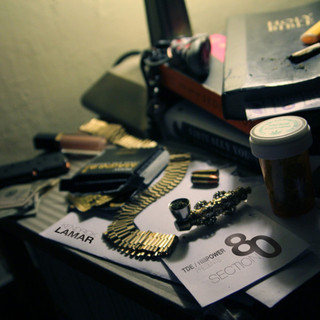
Colour:
The colours used in the cover of this digipak are dark oranges, greens and whites. The orange is used because it represents deceit and distrust. In the album the phrase 'Bliss and Disobedience' is used twice, I think this links in with deceit and distrust because it paints the audience a picture of this generation that to not care about breaking the rules and deceiving. As opposed to the dark greens we see because they represent harmony and safety. I think Kendrick Lamar had used this as an oxymoron for what the album is about, or rather what he wishes the way he grew up as an '80's baby' was more like this. This theme continues through the use of white, which represents virginity and purity. On the album songs such as 'Keisha's Song' and 'Tammy's song' are about girls who have been turned to selling their body or being abused by men for money or security and this is why the white is an oxymoron.
Wording/Font
The font on this digipak is simple and the reason behind this is because Section80 wasn't very popular upon release and it's only Lamar's third album and from what we can see on his two previous albums (Kendrick Lamar - 2011 and Overly Dedicated - 2010) the trend of understated font continues. In my opinion, the font suits the album because he is sending a message but he is not forcing you to hear it, this matches the font in the sense that it wouldn't stand out on the shelves however if you wanted to hear it, you would pick it up. Again wording is relatively simple as Section80 refers to his neighbourhood and the only other words on the front cover are his name and the Holy Bible. There are religious messages through out the album so the Bible makes sense and also tells the audience what to expect on the album.
Choice of Images
I think this front cover has managed to fit a lot of aspects of the album onto a picture. In the frame we can see gun clips, condoms, lipstick and a Bible. These objects all together in one picture in unheard of and this was confirmed by Lamar in an interview where he said that they are 'the taboos of the world' he admits that the cover caused him to receive criticism. He goes on to say that the reason he has out these all together is because they may not be seen as the norm, however it would be understandable for a young man from Compton to posses these items all on the same table because he is still trying to find himself and that he's only human. The back of the album is the same picture but cropped to the part that says Section80 just to give the album and name even if you were to look at the back.
Design/Layout
Unfortunately, because the album is old and not very well known, there are not any images if the inside cover, but what I can comment on is the placement of the text on both the front and back cover. On the front the text is attached to the image in such a way that is trying to make the audience believe it really is on the items, he has managed to make the title look inconspicuous which I think is what he had in mind for this album. The back of the album is like most others because it just has the name of the songs on there and what number track they are, however, an interesting note is that he has placed all the producers on the tracks they produced, I think he has done this so he can tell the audience directly that J Cole produced Hii-Power which may of helped sales, by networking with a successful artist.
Monday, 2 February 2015
Curtain Call Digipak Analysis (DONE)
 |
| Inside Cover |
 |
| Front Cover |
 |
| Back Cover |
Eminem's
album 'Curtain Call' was released in 2005 and is Eminem's '6th'
album. This is debatable because it's not studio recorded it's a best
hits album. It comes in between the albums named Encore (released in
2004) and Relapse (released in 2009). In my opinion the album cover
suggests that Eminem is retiring or putting music on the backseat.
This is made obvious by the name, Curtain Call - the
appearance of one or more performers on stage after a performance to
acknowledge the audience's applause. Going back to my point about him retiring it appears as though he's ready to take credit for all of his work and end his career. The roses on the stage indicate that the crowd love him. The roses are a sign of appreciation for the performer, because he's put on a good show, this could relate to his career, it's made a lot of people appreciative and their showing his appreciation. Curtain Call is written in a green font, there are interesting meanings to the colour green, in a positive sense green portrays relaxation a tranquillity, as if to say Eminem didn't want to make a fuss when he retired. On the contrary green can portray deterioration and rotting, maybe suggesting that he was fading away and his time was up leading the Hip-Hop genre. The front of this digipak does not follow the conventions of it's genre. For me this album started off a trend is this particular genre where rappers can express themselves even if they are not feeling aggressive or threatening. Tupac Shakur also had this approach with his songs such as Ghetto Gospel, but wasn't around long enough to start a trend and the harder side of Hip-Hop prospered. This harder side of the genre can be seen on the inside cover, this may be because he does want to stay true to the genre that he has spearheaded for years. Also the songs on the album would not suit the digipak if it was all done in a classic style. On the other hand you could say that he wasn't 'brave' enough to completely disregard the conventions of the genre because it had never fully been done before. The image choice for the outside is pretty standard for the look he was going for, we can see on the inside cover that he has made an interesting decision to include a threatening image of him holding a pistol, this forces the audience to 'stare down the barrel'. In theory this would put the audience in a difficult position (if it was a real gun). I think he has used this to put the audience in his position, maybe suggesting that retiring from music was forced because he was pinned down by a theoretical gun. All of these factors, in my opinion, communicate his position to his audience, and say that he wasn't or isn't necessarily in a good place. I also think that the digipak does not communicate the genre to the audience, but Eminem has done this on purpose because he wants to be seen as a maverick and seen to disregard the conventions of his genre.
Thursday, 18 September 2014
Music Video Analysis - Paradise (DONE)
Coldplay - Paradise
Paradise was a single from Coldplay's fifth studio album 'Mylo Xyloto'. The song was originally written for X-Factor winner Melodie Amaro. The album has singles on it such as 'Princess of China' and Every Teardrop is a Waterfall. Both of these videos took a narrative route as well as Paradise. The video starts off with the opening titles on the screen with a background of a wild scene. This immediately cuts to a scene of an 'elephant' behind bars who lets out a sigh. This maybe to show what the dreams of the elephant are, to be in the wild. This sets off the theme of the video which are for the elephant to escape to the wild. We see the elephant adding to a tally which appears to be the days he's been trapped. This is similar to humans in prison and this personifies the elephant because he acts in the same way. He then begins frantically trying to escape and breaks the lock open. We see the elephant run out of the 'zoo' being chased by two police men which again personifies the situation because normally policemen would not chase an 'animal' from a zoo. The following shots are short sharp shots to increase the intensity of the video. We can tell from the speed of the shots that the elephant is close to reaching the way out of his situation and we see this when he clocks a heathrow airport sign on the tube and the next shot cuts to him hiding in a hangar at an airport. After getting on the plane the elephant arrives at his destination and we can see this with the combination of a shot of his plane touching down and an establishing shot of the new scenery. The next few seconds is filled with multiple shots combined but they all share the same background. We can see the elephant dancing and holding boards with the lyrics on them.

There's also a board asking for money laid on the ground which makes the audience realise that the elephant is busking for money. The elephant then arrives at a bicycle shop and immediately the audience knows he wants to buy one because he's been raising money. He then puts the money he raised on the counter and points to a bike that he wants, to then get told he can only afford a unicycle. This makes the audience feel sorry for the character whilst at the same time feel happy because he's found a mode of transportation. The following shots are a sequence of frames showing him riding his unicycle along roads and tracks until he finally reveals himself as being Chris Martin, the frontman of Coldplay. This finally makes us realise why they have been trying to personify the elephant, because it was a human. The video is edited chronologically because all the shots of the elephant reaching his destination come in order of events, and there is only one flashback which features at the very start. After a few establishing shots, we can see the same wild scene as we saw at the start, this means that the start was not the dream for the 'elephant' but was a flashback, the colour of this setting in the set set dark orange, this is because orange represents enthusiasm, determination, strength, endurance, success and encouragement. It also gives the sensation of heat, which re-enforces the location that the video is set. This links in with the target audience because the colour orange is 'highly accepted' among young people. The next shot is a shot of the elephant walking in a field with unicycle in tow, this in when we first see more wildlife in the form of giraffes, and finally we see the rest of his 'heard' in the form of his bandmates dressed in elephant costumes.

This makes the audience aware that the rest of the video will not have a narrative as the elephant has finally reached his destination. This is right because the rest of the video is indeed performance based. The video switches almost seamlessly from characters in a desert to the characters doing a live performance on stage. They are still wearing the elephant heads though so they were prepared to film part of the video when they performed live.
Friday, 12 September 2014
Media Theorists (DONE)
Binary Opposites
Claude Levi Strauss
He believed that the way we understood certain words depends not so much on their actual meaning but by our understanding it’s ‘opposite’. He then produced the theory binary opposites. A protagonist and antagonist or Heroine and villain are both examples of binary opposites. Binary opposites are very frequently used in films, especially in the horror genre, many of the films include binary oppositions in their plots. Good and evil is the most common binary opposite shown to the public through the media field on different platforms. They are usually the basis of our understanding of a story as it is a conventional narrative and are used in music videos as part of a narrative to reinforce song lyrics. Levi Strauss’ theory coincides with our 'ideological' perspectives in the world. He also stated that there is a human need to classify.
The Male Gaze
Laura Mulvey
Claude Levi Strauss
He believed that the way we understood certain words depends not so much on their actual meaning but by our understanding it’s ‘opposite’. He then produced the theory binary opposites. A protagonist and antagonist or Heroine and villain are both examples of binary opposites. Binary opposites are very frequently used in films, especially in the horror genre, many of the films include binary oppositions in their plots. Good and evil is the most common binary opposite shown to the public through the media field on different platforms. They are usually the basis of our understanding of a story as it is a conventional narrative and are used in music videos as part of a narrative to reinforce song lyrics. Levi Strauss’ theory coincides with our 'ideological' perspectives in the world. He also stated that there is a human need to classify.
The Male Gaze
Laura Mulvey
The gaze is the way certain members of
an audience view the characters who are being portrayed within a
production.
For feminists it can be seen in 3
different ways:
- How men look at women
- How women look at themselves
- How women look at other women
Gaze and Feminist Theory:
Laura Mulvey came up with the male gaze
theory in 1975. She believes that every member of an audience should
view characters from a heterosexual male’s point of view.
Features of the Male Gaze:
Laura Mulvey believes that the camera
lingers on the curves of the female body. She also believes that
women’s activity within a piece of film is largely presented in the
context of a man’s reactions to those particular activities or
events. This could portray women as objects. For example, in the song
‘Loyal’ by Chris Brown he suggests that riches will easily cause
a girl to convert from her current partner. This supports Laura
Mulveys theory because this is how a male might interpret women.
Counter Argument:
Some women enjoy being looked at
It could also be aimed towards the same
gender and sexually irrelevant. Eg. Body image or clothing.
A good example of the male gaze is Shakira's video featuring Rihanna - Can't Remember to Forget You. The whole video consists of the two women dancing in a provocative way and dressed in next to nothing. This is clearly because the video would do very well on television and even youtube people would definitely watch it more than once.
A good example of the male gaze is Shakira's video featuring Rihanna - Can't Remember to Forget You. The whole video consists of the two women dancing in a provocative way and dressed in next to nothing. This is clearly because the video would do very well on television and even youtube people would definitely watch it more than once.
Goodwins theory
Goodwins main points:
- The link between the lyrics and the visuals within a music video
- The link between the music and the visuals within a music video
- Genre characteristics
- Intertextuality references
- Notions of looking
- Voyeurism
- Demand of the record label
- Performance based, concept based or narrative based music videos
Lyrics and visuals
This is where the lyrics within a song match the visuals
that are occurring within the music video. For example, when Lethal Bizzle
sings, “Rari Worout” he is seen to be doing a ‘workout whilst in a Ferrari
(Rari).
Music and visuals
This is where the pace of the music matches either the
intensity of the music video or the speed of the cuts. For example, in Martin
Garrix’s ‘Animals’, the pace of the cuts speed up when the beat ‘drops’.
Genre Characteristics
Genre characteristics is when the mise en scene and
activities within the music video match the usual representations of that
specific genre. For example, in the music video of drakes ‘started from the bottom’
he is seen to be in extremely flashy cars and clothes. This suits the usual
representation of the hip-hop/rap genre.
Notions of looking
The notion of looking theory is simply the idea of how when the
artist of the song looks into the camera, it feels like you are being involved
in the music. For example, in the black eyed peas ‘where is the love?’
will.i.am looks into the camera an awful a lot. This could not only draw the
consumer in but make them feel like part of the band.
Demand of the record label
The record label will demand certain things within the music
video that suits such things as age group or genre. An example being a party
atmosphere or certain objects. The reason for this is because the label may
believe that certain things would sell more, therefore make them more money.
Performance based music video
A performance based music video is simply a video of the act
performing on stage (not a live performance). These music videos are used to
get a clear message across to the consumer. This is done by the performers
using very clear gestures, therefore clearly expressing their emotions. For
example, in the Outkast’s, ‘Hey ya’ video they are jumping and dancing around
the stage. This shows that they are extremely happy, which matches the ‘feel good’
song.
Wednesday, 10 September 2014
History of the Music Video (DONE)
History of the Music Video
A music video is an illustration behind the sound track of a song. The purpose of a music video can be viewed in two ways; the way that music videos can be shown on television rather than the now dying out platform of radio. This means that they can advertise or self promote on television as well as radio. It can also be seen as a way to tell the story behind a song without making it clearly obvious through sound.
1894 - The video ever made could be compared to a slideshow rather than a video, mainly because they had no way of filming so they had almost a flipbook initiative, this was aided by the invention of the zoetrope earlier in the 19th century, which made pictures spin in between frames making the eye believe they were moving, however this video was made using a 'magic lantern' which uses light to project a picture onto a screen, like the modern projector. The music was over the song 'The Little Lost Child' and consisted of a man playing violin whilst another man sang, it was created by Edward B Marks and John Stern. If you fast forward to 1929, the music video concept, created by Marks and Stern, was called a 'Talkie' short for 'talking picture'. In the same year Bessie Smith's song St. Louis Blues was recorded as a dramatised film even though it was released four years prior to the release of the original song. 1956 saw the production of the first 'music video' which was set to Tony Bennett's 'Stranger in Paradise' which aired on 'American Bandstand' an American TV show, a year later, Elvis Presley's Jailhouse Rock was released. In 1961 music videos were starting to be made in a more conventional manner, i.e. recording certain visuals paired with lip syncing eventually overlaid on a music track, on Canadian TV show 'Singalong Jubilee'. Three years later the Beatles took part in the mockumentary feature film 'A Hard Days Night' which was filmed in black and white. 1974 saw the birth of music television in Australia with 'Countdown' and 'Sounds Unlimited' or 'Sounds', where producers would show music videos or even make a backing video for a track that didn't previously have one. Countdown followed suit when they realised that their was money in this way of marketing music, and Ian Meldrum, the man who realised this would go on to have Paul Drane produce music videos for AC/DC, as well as producing The Buggles' 'Video Killed the Radio Star' which was the first music video to be played on MTV in 1981.
Tuesday, 9 September 2014
Who am I? What am I even doing? (DONE)
Who am I?
I am Ben Oxford.
What am I doing?
I am doing Media Studies at A2 level. As part of my course I am going to make a music video, I am thinking about several videos to re-create, but for me one in particular stands out as being the most suitable. This would be 96 F*ckries by JME. This song fits in perfectly with my previous research and my knowledge for the genre would indicate that it is the most suitable.
What happened last year?
Last year I created a film opening to a reasonable standard which received marks in the high 50's. Im looking to replicate that this school year with a member of my last project.
I am Ben Oxford.
What am I doing?
I am doing Media Studies at A2 level. As part of my course I am going to make a music video, I am thinking about several videos to re-create, but for me one in particular stands out as being the most suitable. This would be 96 F*ckries by JME. This song fits in perfectly with my previous research and my knowledge for the genre would indicate that it is the most suitable.
What happened last year?
Last year I created a film opening to a reasonable standard which received marks in the high 50's. Im looking to replicate that this school year with a member of my last project.
Subscribe to:
Posts (Atom)